
The rules of search have fundamentally changed. If you're evaluating SEO companies in Toronto using the same criteria you would have in 2023, you're about to make an expensive mistake.
Here's why: while most Toronto agencies are still selling traditional SEO packages focused exclusively on Google rankings, the search landscape has quietly fractured into multiple platforms. ChatGPT now serves over 800 million users. Perplexity handles 22 million active searches monthly. And according to University of Virginia research from June 2025, 60% of consumers now use AI to help them shop.
The uncomfortable truth? Traditional search volume is predicted to drop 25% by 2026 and 50% by 2028, replaced by generative engines that answer questions without sending users to websites at all.
This means hiring an SEO company that only optimizes for Google is like investing in a horse-and-buggy upgrade when everyone else is buying cars. You need an agency that understands both traditional search engine optimization AND generative engine optimization (GEO)—the practice of making your brand visible and citable in AI-generated responses.
Why Traditional SEO Alone Won't Cut It for Toronto Businesses in 2025
Let's address the elephant in the room: traditional SEO isn't dead. It's still the foundation. But it's no longer sufficient on its own.
The Multi-Engine Reality
Think about how your customers search today. They still type queries into Google, yes. But they're also asking ChatGPT for product recommendations, using Perplexity to research service providers, and querying Claude for comparative analysis.
Here's what makes this urgent: when someone searches "best accounting firm in Toronto" on Google, you might rank #5 and still get clicks. When someone asks ChatGPT the same question, it synthesizes one response citing 3-5 sources. If you're not in that synthesis, you're invisible.
The data is stark: only 3 out of the top 100 Toronto SEO agencies even mention generative engine optimization in their service descriptions, despite it becoming table stakes for B2B brands throughout 2025.
Toronto's Competitive Amplification
Toronto's business environment has always been intensely competitive. Now multiply that competition by the fact that AI search engines collapse dozens of potential website visits into single consolidated answers.
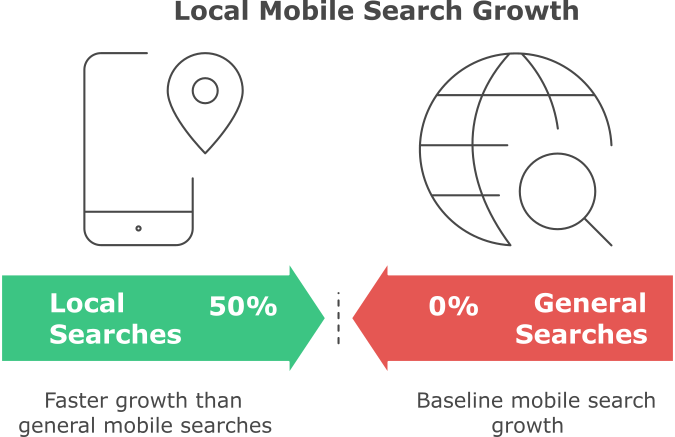
Local mobile searches are growing 50% faster than general mobile searches. Google Business Profile results now include zero-click answers that satisfy queries without users ever leaving Google. And 64% of consumers used Google to find local businesses in the past week—yet only 44% of Canadian small businesses even have websites.
The gap between optimized and non-optimized Toronto businesses is widening exponentially.
SEO vs GEO: Understanding the Two-Pronged Approach
Let's demystify what you should be getting from a modern SEO company.
| Aspect | Traditional SEO | Generative Engine Optimization (GEO) |
|---|---|---|
| Primary Focus | Google rankings & organic traffic | AI search citations & brand mentions |
| Key Tactics | Keywords, backlinks, technical fixes | Structured data, semantic clarity, citation-worthy content |
| Measurement | Rankings, traffic, conversions | AI Visibility Rate, citation frequency |
| Timeline to Results | 3-6 months for meaningful traction | 2-4 months for first citations |
| ROI Indicators | Organic revenue growth, lead volume | Brand authority, cross-platform visibility |
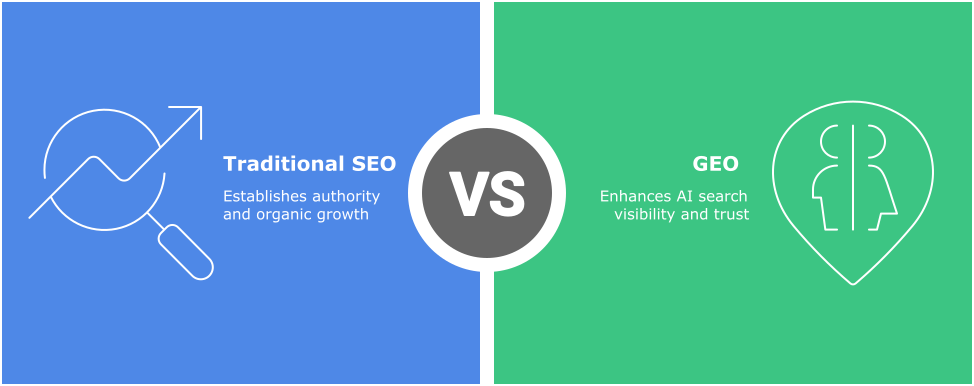
Traditional SEO: The Foundation
Traditional SEO remains critical and includes technical optimization (site speed, mobile responsiveness, crawlability), on-page optimization (keyword integration, header hierarchy, internal linking), and off-page optimization (backlink acquisition, brand mentions, digital PR).
The ROI is well-documented. One Toronto-based case study showed 103% organic revenue growth within three months of implementation. But here's the key: that success came from treating traditional SEO as the foundation for a broader visibility strategy, not the complete strategy itself.
GEO: The New Frontier
GEO focuses on making your content extractable and citable by AI search engines through structural clarity, semantic optimization, citation-worthy content, and schema implementation.
Early adopters are seeing compelling results. One documented case showed a 65% lift in AI search visibility within months. Another demonstrated that brands appearing in AI-generated responses experienced higher trust scores—the AI citation itself became a credibility signal.
Why Top Agencies Do Both
Strong traditional SEO creates the authority signals that make you citation-worthy in AI responses. Effective GEO restructures that authority into formats that AI engines can extract. Together, they create compound visibility across the entire search ecosystem.
Research shows that 50% of sources cited in AI Overviews also rank in the top 10 traditional results—SEO and GEO reinforce each other.
7 Questions to Ask Any Toronto SEO Company in 2025
These questions will separate sophisticated agencies from outdated ones.
1. Do You Optimize for AI Search Engines Like ChatGPT and Perplexity?
If they look confused or say "we focus on Google," pivot away. The right answer includes specific tactics: schema markup, content restructuring for semantic clarity, citation tracking, and client examples.
2. How Do You Track Brand Citations in AI-Generated Responses?
Ask about AI Visibility Rate and Citation Frequency tracking. If they can't articulate a methodology, they're not actually doing GEO work.
3. What's Your Approach to Schema Markup and Structured Data?
They should discuss Organization, FAQ, HowTo, Local Business, and Article schema—explaining how structured data improves both traditional rich results and AI parseability.
4. Can You Show Me a Toronto Client's AI Visibility Report?
Request actual reports showing which AI platforms cite the client, for which queries, and how visibility has changed over time.
5. How Do You Balance Local SEO with Generative Search Optimization?
They should explain Google Business Profile optimization, review management, and neighborhood-specific content—while structuring information for AI extraction.
6. What's Your Process for Adapting to Google's AI Overviews?
They need specific strategies for appearing in AI Overviews, which now appear for many queries above traditional results.
7. How Do You Measure Success Beyond Traditional Rankings?
A comprehensive framework includes traditional metrics (traffic, rankings, conversions), AI visibility metrics (citation frequency, brand mentions), local metrics (GBP views, calls), and authority metrics (domain authority, brand search volume).
Realistic Timelines and ROI for Toronto SEO + GEO Services
Let's talk numbers. The SEO industry has a credibility problem because too many agencies promise unrealistic results.
Results Timeline Comparison
| Timeframe | Traditional SEO | GEO Implementation |
|---|---|---|
| Months 0-3 | Foundation building, technical fixes, initial content. Minimal ranking movement. | Content restructuring, schema deployment. No immediate citations. |
| Months 3-6 | Rankings improve for low-competition terms. 20-40% traffic growth expected. | First AI citations appear. 40-65% lift in AI visibility possible. |
| Months 6-12 | Compound growth. Competitive terms rank. 100%+ revenue growth documented. | Sustained citation presence creates authority flywheel. |
Toronto SEO Pricing Reality (2025)
| Monthly Investment | What You Get | Best For |
|---|---|---|
| $1,000-1,500 | Basic optimization, 2-4 content pieces, standard reporting. No comprehensive GEO. | Small businesses, low-competition niches |
| $1,500-3,000 | Technical SEO, 4-8 content pieces, strategic link building, basic GEO, detailed reporting | Most Toronto SMBs |
| $3,000-5,000+ | Everything above plus competitive analysis, advanced GEO, PR integration, dedicated management | Competitive industries (legal, medical, finance) |
Red Flags to Avoid
Run from agencies that guarantee specific rankings, promise immediate results, or use outdated tactics like buying links or keyword stuffing. No legitimate agency can guarantee #1 positions—Google's algorithm includes hundreds of proprietary factors.
Toronto-Specific SEO Factors Out-of-Market Agencies Miss
Generic SEO knowledge isn't enough. Toronto has unique search dynamics.
Neighborhood-Based Search Behavior
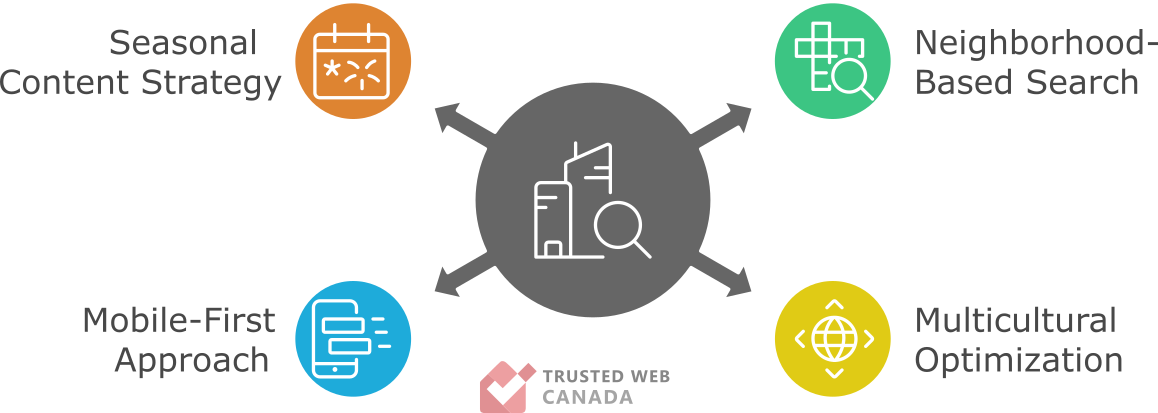
Toronto doesn't search like one city—it searches like dozens of distinct neighborhoods. Someone in Liberty Village won't consider recommendations in North York. Your strategy needs hyperlocal content addressing King West, Queen West, Distillery District, Yorkville, The Beaches, and Leslieville individually.
Multicultural, Multilingual Optimization
Toronto is one of the world's most diverse cities. Effective SEO considers multilingual search behavior across English, French, Mandarin, Cantonese, Punjabi, and Tagalog. Even English-language optimization should consider cultural context and varying trust signals.
Mobile-First Urban Reality
Mobile search dominates Toronto's urban core. Local mobile searches are growing 50% faster than general mobile searches nationally. Your mobile optimization needs flawless site speed (under 2 seconds), thumb-friendly navigation, click-to-call functionality, and map result optimization.
Seasonal Climate-Driven Patterns
Toronto's search behavior shifts dramatically with seasons. Winter drives indoor searches and home-service demand. Summer increases outdoor recreation queries. Smart agencies create evergreen content boosted seasonally rather than recreating content annually.
Red Flags vs Green Flags: Spotting the Right Partner
| Red Flags (Run Away) | Green Flags (Move Forward) |
|---|---|
| No mention of AI search optimization | Active discussion of GEO strategies without prompting |
| Guaranteed rankings or #1 position promises | Probability-based timelines with clear reasoning |
| Preset packages with zero customization | Customized strategy proposals after learning your business |
| Vague or no reporting transparency | Clear attribution methodology for all metrics |
| Outsourced work disguised as in-house | Toronto-specific case studies with documented results |
| Resistance to questions about methodology | Investment in AI citation monitoring tools |
| "Results in 2-6 months" without context | Regular proactive communication about algorithm updates |
Your 30-Day Action Plan
Week 1: Audit Your Current Visibility
Check your Google rankings for key terms. Ask ChatGPT, Claude, and Perplexity questions your customers would ask—see if your business appears. Review Google Business Profile metrics. Document your baseline.
Week 2: Shortlist GEO-Capable Agencies
Research Toronto agencies explicitly mentioning AI search optimization. Create a shortlist of 3-5. Check their own visibility—if they can't rank and appear in AI responses themselves, they probably can't do it for you.
Week 3: Conduct Strategic Consultations
Schedule calls using the seven questions outlined earlier. Pay attention to how they answer: Do they educate or obfuscate? Do they ask insightful questions about your business? Request detailed proposals with specific deliverables, timelines, and pricing.
Week 4: Review and Verify
Compare proposals side-by-side based on strategy comprehensiveness, clarity of deliverables, and measurement methodology. Call references and ask specifically about communication quality, result delivery versus promises, and how the agency handled challenges.
First 90-Day Milestones
| Timeframe | Expected Deliverables |
|---|---|
| Days 1-30 | Comprehensive audit, strategy document, technical issue identification and prioritization |
| Days 30-60 | Critical technical fixes implemented, initial content published, schema markup deployed, baseline reporting |
| Days 60-90 | First ranking improvements, traffic growth indicators, initial AI citation tracking data |
The Bottom Line
The Toronto SEO market has fundamentally transformed. Success now requires agencies that understand traditional search engine optimization (SEO) and emerging generative engine optimization (GEO) as integrated strategies that compound each other's effectiveness.
The agencies still selling 2023-era SEO packages will deliver 2023-era results: incomplete visibility that leaves you vulnerable as search behavior continues fragmenting across platforms.
Your competitive advantage doesn't come from having an SEO company. It comes from having the right SEO company—one that's already preparing for the search landscape of 2026 and beyond while delivering measurable results today.
Now you know exactly how to find them and work with the right SEO specialist.
Get Your Free SEO Audit
Trusted Web Canada offers complimentary SEO audits and consulting services to help Toronto businesses evaluate their current visibility across both Google and AI search platforms. Our audit identifies technical issues, content gaps, and AI optimization opportunities—giving you a clear roadmap to rank everywhere. Contact us today to discover where your business stands in the evolving search landscape.